The rating certificate is on the wall. The filters were validated on time, the pressure differentials are recorded, and the particle counts are within limits. For every measurement that is recorded, the system works. And yet contamination deviations occur. Not because the system fails, but because a certified system is a statement about the equipment, and almost everything that actually enters a clean room does so by walking through the door.
The Classification Measures the Room at Rest. Your Product Is Made When It Is Not
A classification can be established in rest, with the equipment running and no one inside, or in operation, with people working as they normally do. Both are legitimate classifications. Only one says something about the environment in which their product is exposed, and the difference between the two numbers is made, complete, by human activity.
A person at rest releases particles continuously; the same person walking releases several times more. Rapid movements, stretching over a station, or turning suddenly on a table raise the local count for a few seconds, right where the product is. None of that appears in a monthly report averaged per shift, and none of that is a failure of the room.
The Gowning Room Is the Most Important Process Step
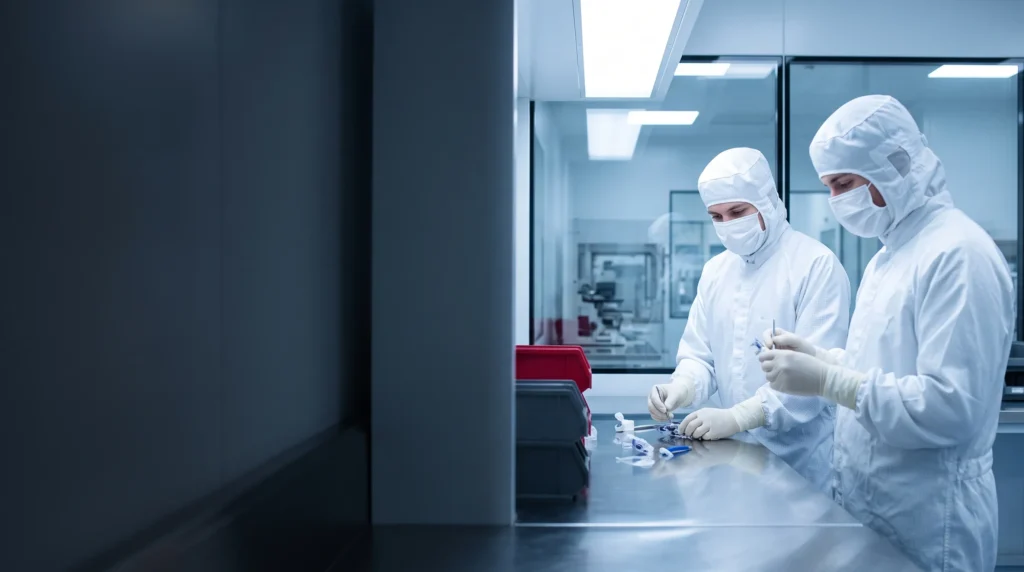
The dressing room is probably the most consequential step of the entire operation, and the one that was most likely trained once and never revisited. The sequence has an order to it; the transitions between dirty and clean sides are where the technique fails, and the moment a sleeve touches the bench or a glove touches the face mask, the gown ceases to be a barrier. People don’t get worse by dressing carelessly. They gradually drift away, because no one has observed them for eleven months.
The Flow Is Designed Once and Tested Every Shift
A clean room is designed with direction: material enters through one route, personnel through another, waste exits through a third, and the pressure cascades from the cleanest space outward. Then comes the reality of production. A cart is parked where it fits and not where it goes. A door stays open for two minutes during a model change. Someone takes an shortcut through a room they shouldn’t have crossed. Each thing is trivial in itself, and each goes against the design that led to the rating.
And that’s what comes with the material. The cardboard, the wooden planks, and the plywood have nothing to do with the spill after all, and everyone knows it. What happens on a Friday afternoon is that a box arrives a quarter of an inch further in than it should have, because the transfer table was occupied. The quarter didn’t change. The discipline did.
The certificate answers a question about the room
None of this is an argument against qualification, which is necessary and non-negotiable. It is an argument that the certificate answers a question about the room, and the question that keeps your product clean is about the people inside it. That one has no annual test. It is answered every shift, depending on whether someone with authority is watching technique and is willing to correct it on the spot.
How Our Personnel Behave Inside Your Clean Room
- Gowning trained against their procedure. Your sequence, your garments, and your airlock, demonstrated before the first shift; not a generic onboarding delivered somewhere else.
- Supervision on the floor, not on paper. A RIDYS supervisor inside the room with the crew, observing technique and correcting deviations on the spot.
- Stable crews, not rotating faces. The same people in the same operation, because discipline is built with repetition and destroyed with a new face every week.
- A record you can show an auditor. Qualification records per person, traceable to the lots they worked, delivered to your quality department. We explain how that file is built in Your Inspectors Are Qualified. Can You Prove It?
About our scope: RIDYS Group provides inspection, sorting, rework, and on-site technical personnel for components, devices, and packaging. We do not qualify clean rooms or perform environmental monitoring, and we do not hold ISO 13485 certification or registration under 21 CFR Part 820. Our personnel work within your quality system, follow your gowning and behavior procedures, and product release decisions are entirely yours.
Stand in your gowning room during a shift change and just watch. If you’d like, tell us your cleanliness class and your gowning procedure and we’ll explain how we qualify a crew against them.